

Endo Mastery

Coaching Tip: 6 practice priorities for women endodontists

Trish - ARTICLE500

The desire for a successful endodontic practice is universal among all endodontists, regardless of any other factor. However, the priorities or methods that go into practice success can vary depending on certain factors. An easy example is age of the doctor. Younger doctors have different priorities than older doctors.


As a coach, one factor that does make a real difference in doctor priorities is women endodontists. Women are often juggling home and family responsibilities in combination with (and sometimes in competition with) their practice responsibilities.


Here are some tips that can add up to a big improvement in the lives of women endodontists. Again, these can equally apply to any practice owner, but in my experience, they tend to be prioritized higher for women.

  • Have a professionally trained office manager who you trust completely, and who is enthusiastically aligned to your vision and goals for the practice.

    A great office manager understands the business of the practice and can strategize independently and lead the team to carry out your goals without a lot of intervention required by you.

  • The first patient of the day should be seated and ready for you when you are ready to begin. That means if your day starts at 8:00 am, your first patient should be in the practice before that and have completed all their paperwork and initial process with your dental assistant so you can start on time without waiting.

    Starting on time is the first step to staying on schedule and not falling behind or being stressed during the day.

  • Have a scheduling template that is designed to support same-day emergency appointments … especially in the afternoon. This is essential to be able to accommodate emergency patients while still allowing the doctor and team to finish and leave the practice on time.

    Protecting family time is vital, and if all treatment slots are full before the day starts, an emergency case is going to result in the doctor and team running late and leaving late.

  • Balance the number of days you need to work with your level of productivity on a daily basis. With higher daily productivity, you can reduce your time in the practice with the same results (or better). For example, a doctor working 5 days per week and completing 20 cases (average doctor) can reduce to 4 days per week if their clinical team improves efficiency and can complete 5 cases per day.

    The impact of this is powerful in many ways, including days per week, hours per day, and vacation time per year. If a doctor can add two cases per day, they really open up a lot of flexibility and opportunities for free time while increasing their income.

  • Delegate to your assistants. Doctors should primarily do what a doctor is legally required to do. As much as possible, train your assistants to cover everything else.

    A huge time saver that prevents doctor from having to take a lot of work home is to have assistants prep treatment notes and referral reports as the day is proceeding. This can be templated and then the doctor simply reviews, tweaks and signs off.


  • Finally, respecting that women doctors are also often taking the lead in childcare, there will inevitably be unplanned situations when the doctor must be absent on short notice (for example, a sick child at home or being called to the school unexpectedly). Make sure your team has a rock-solid process and excellent verbal skills to smoothly reappoint scheduled patients when needed.

What makes a practice really “work” for any doctor is often found in the little details. These details add up and snowball to ideally support the way the doctor wants to work, the team environment that enables them, and their vision for the practice.

To learn more about Endo Mastery practice and team coaching:
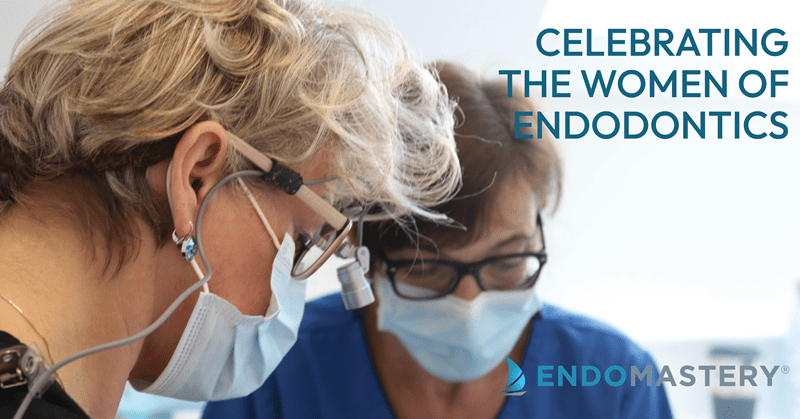
Celebrating the women of endodontics

DR. ACE GOERIG

OWNER & CO-FOUNDER
DDS, MS, ABE Diplomate

While dentistry (like most professions) was predominantly male in the past, that will not be the case in the future. Currently, both sexes comprise approximately 50% of first-year dental students, with the women edging out the men slightly. The same trends are reflected in endodontic residencies, so the future of endodontics will be fully balanced demographically.


We know it has taken a lot of social progress to get to this point of equal representation. However, most people don’t know that women in dentistry were part of our profession from the very beginning.

History of women in dentistry

The 1800s were a busy time for the professionalization of dentistry:

  • The first dental college, Baltimore College of Dental Surgery, opened in 1840.
  • Alabama became the first state to regulate professional dental standards in 1841.
  •  The American Dental Association was founded in 1859.
  •  Harvard Dental School, which was the first university-affiliated program to offer doctorate degrees, opened in 1867.

During this time, there were some notable women who opened the door in dentistry right from the beginning:

  • In 1855, Emeline Roberts Jones became the first woman to practice dentistry. She started as an assistant to her husband, a dentist, and learned dental treatments from him.
  • In 1866, Lucy Hobbs Taylor was the first woman to graduate from a dental school. She had been finally accepted into the Ohio College of Dental Surgery, after being denied previously on the basis of her sex.

By 1900, over 1000 women had followed these pioneers into the field. In 1928, the American Association of Women Dentists (AAWD) was founded, which pre-dates the American Association of Endodontists by 15 years, and endodontics as a recognized dental specialty by 35 years.

The AAWD describes their mission as:

By 1900, over 1000 women had followed these pioneers into the field. In 1928, the American Association of Women Dentists (AAWD) was founded, which pre-dates the American Association of Endodontists by 15 years, and endodontics as a recognized dental specialty by 35 years.


The AAWD describes their mission as:

“Our goal is to continue being the leading resource for advancing, connecting and enriching the lives of women dentists. We serve our members by offering a variety of programs and services that benefit the special needs of the busy woman dentist.”

Check out the AAWD website for more information.

Practice and team success in women-led practices

The success of female endodontists is reflected in the success of their thriving practices. At Endo Mastery, women endodontists working with our coaches prove that it’s possible to build successful, profitable practices while keeping a healthy work-life balance. This is particularly relevant given that women often still carry a greater share of home and childcare responsibilities.


Many female endodontists are known for their patient-centered approaches, emphasizing communication and empathy. This aligns with studies that suggest patients often perceive women in healthcare roles as more nurturing and compassionate. This perception can be particularly beneficial in endodontics, where patient anxiety is common.


And finally, the contributions of women extend beyond the doctors themselves. The majority of support staff in endodontic practices are women, and their roles are crucial in creating a positive patient experience. Their ability to communicate empathetically and provide comforting and reassuring interactions is essential in managing patient concerns and building trust.


There is no doubt that the increasing influence of women in endodontics is a positive development that benefits the entire profession. Their unique perspectives and dedication to patient care are driving innovation and shaping the future of endodontic practices!

SIGN UP

Sign up to receive helpful practice management tips, debt elimination ideas, how to re-energizing your team, and much more.