


Take a proactive step in early March to reinforce one simple message: we make your life easier. A small, thoughtful drop-off gift is all that’s needed. Consider delivering a high-quality small bag of coffee, a modest coffee shop gift card, or a box of premium tea to your referring offices. Keep it professional and useful — not seasonal or themed.
Attach a short card that reads:
For busy spring mornings.
As your schedule fills up, please remember we’re structured for same-day consult and treatment whenever possible. We’ll take excellent care of your patients and get them back to you quickly.

DIRECTOR OF COACHING
In most high-performing endodontic practices, referred patients are scheduled for a consultation with the expectation that, if the diagnosis confirms the need for treatment, the root canal will proceed immediately during the same appointment. Doctor time is reserved. Operatory time is reserved. The schedule is thoughtfully structured for efficiency and patient care.
Yet even with this strong model in place, hesitation can sometimes appear at the very moment where commitment should feel natural.
Case acceptance in endodontics is rarely about persuasion. It is about preparation. When patients are properly prepared during the scheduling call — clinically, financially, and psychologically — same-day treatment feels straightforward and reassuring. When preparation is inconsistent, hesitation appears where it should not exist.
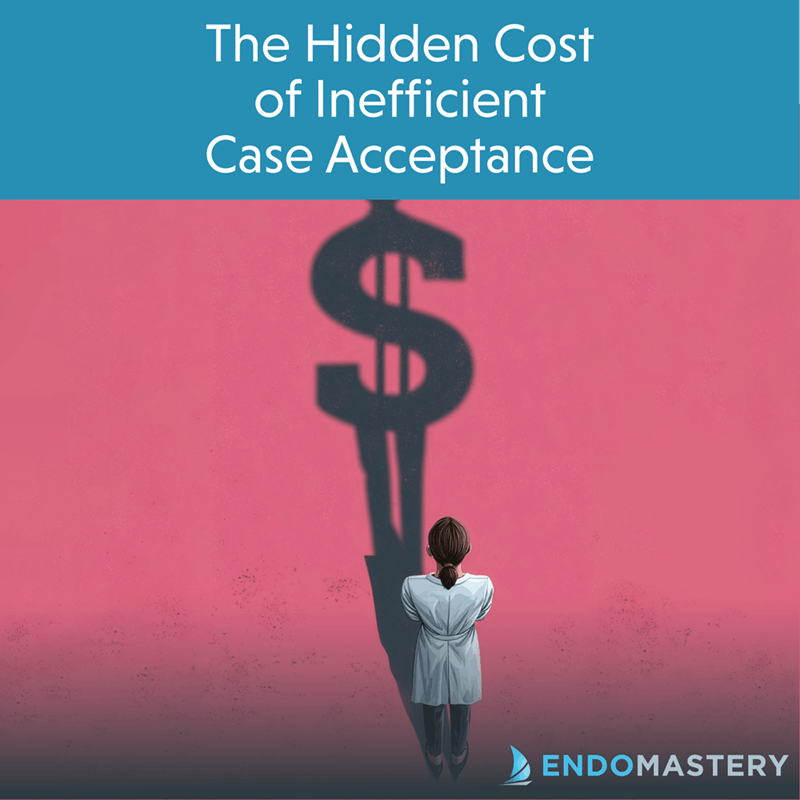
Importantly, when doctor time has already been reserved for treatment, that hesitation and failure to proceed to treatment creates unexpected open time in the schedule. Instead of completing a productive case, the doctor experiences a gap that directly affects daily productivity and practice revenues. Over time, even small inconsistencies can quietly limit growth.
If you want consistent momentum and predictable productivity, case acceptance must be intentionally built into your systems long before the patient arrives.
You will learn:
The Consult-and-Treat Model Requires Clear Expectations
In a consult-and-treat model, the patient should arrive expecting that treatment will proceed immediately if the diagnosis confirms the need for a root canal. That expectation does not happen automatically — it must be clearly and confidently established during the scheduling conversation.
When the administrative team schedules the appointment, they should explain that the doctor has reserved time not only to evaluate the tooth but also to treat it that same day if indicated. Patients should be instructed to allow sufficient time in their schedule and to be prepared financially based on their insurance estimate.
If this framing is vague — or simply assumed — the patient may view the visit as “just a consultation.” That small misunderstanding can create unnecessary friction and potential downtime later.
Clarity before the appointment protects efficiency during the appointment.
Where Case Acceptance Breaks Down
Even in strong practices, there are predictable areas where hesitation can occur.
Insurance Uncertainty
If insurance benefits are not verified thoroughly or explained clearly before the appointment, patients may feel surprised by their out-of-pocket responsibility. Financial uncertainty is one of the most common reasons patients ask to delay treatment.
During the scheduling call, benefits should be verified carefully and communicated with confidence. When there is doubt about remaining benefits or recent treatment in the referring office, it is wiser to estimate conservatively. It is always better to issue a small refund than try to collect a small balance owed by sending a statement after the fact.
When patients understand their financial responsibility ahead of time, same-day treatment feels expected rather than stressful.
Financial Confirmation at Diagnosis
When the doctor confirms the need for treatment, the financial message should feel like a continuation — not a new conversation.
If the administrative team appears uncertain, recalculates numbers in front of the patient, or shifts language in a hesitant way, the patient senses instability. Even subtle uncertainty can introduce doubt.
By contrast, when the financial conversation is calm, structured, and consistent with what was discussed earlier, patients feel supported and confident moving forward.
Language That Introduces Unnecessary Choice
Language matters more than we realize.
If the team says, “Would you like to go ahead with treatment?” it subtly reframes the appointment as optional. In a consult-and-treat model, the schedule has already been structured for care.
Instead, language should reflect that preparation: “We’ve reserved the time today to take care of this for you. We’ll get started so you can be comfortable.”
That small shift preserves momentum and reinforces that the practice is organized around serving the patient efficiently.
Building a Predictable Case Acceptance System
A predictable system begins with thoughtful preparation during the scheduling call. Administrative team members must clearly communicate that the appointment includes both diagnosis and potential treatment, and that doctor time has been intentionally reserved. When patients understand the structure of the visit in advance, they arrive aligned with the practice’s expectations.
Financial policies must also be defined and applied consistently. The team should feel confident explaining when payment is collected, how third-party financing is offered, and how insurance discrepancies are handled. When policies are consistent, the team communicates with greater ease, and patients respond with greater trust.
Equally important is alignment between clinical and administrative messaging. The clinical assistant reinforces the importance and urgency of care. The administrative team reinforces clarity and simplicity around logistics and payment. When these conversations feel unified, the patient experiences continuity. That continuity builds confidence.
The Advantage of Being Proactive
Referred patients are often motivated and in discomfort. Your consult-and-treat model is designed to serve them quickly and compassionately. But compassion and productivity both depend on preparation.
When scheduling conversations set clear expectations, when insurance is verified accurately, and when communication is confident and consistent, same-day treatment becomes the natural outcome.
Case acceptance is not about convincing patients. It is about removing uncertainty. When uncertainty disappears, productivity improves — and the practice feels smoother, lighter, and more predictable for everyone involved.
Key Takeaways
Unified communication creates seamless patient flow
Get Clarity and Confidence
If this article resonated, a Discovery Call with Endo Mastery is a helpful next step. It’s a brief, no-pressure conversation designed to bring clarity to where your practice is now and explore what opportunities may exist to move forward with confidence.
| Cookie | Duration | Description |
|---|---|---|
| cookielawinfo-checkbox-analytics | 11 months | This cookie is set by GDPR Cookie Consent plugin. The cookie is used to store the user consent for the cookies in the category "Analytics". |
| cookielawinfo-checkbox-functional | 11 months | The cookie is set by GDPR cookie consent to record the user consent for the cookies in the category "Functional". |
| cookielawinfo-checkbox-necessary | 11 months | This cookie is set by GDPR Cookie Consent plugin. The cookies is used to store the user consent for the cookies in the category "Necessary". |
| cookielawinfo-checkbox-others | 11 months | This cookie is set by GDPR Cookie Consent plugin. The cookie is used to store the user consent for the cookies in the category "Other. |
| cookielawinfo-checkbox-performance | 11 months | This cookie is set by GDPR Cookie Consent plugin. The cookie is used to store the user consent for the cookies in the category "Performance". |
| viewed_cookie_policy | 11 months | The cookie is set by the GDPR Cookie Consent plugin and is used to store whether or not user has consented to the use of cookies. It does not store any personal data. |